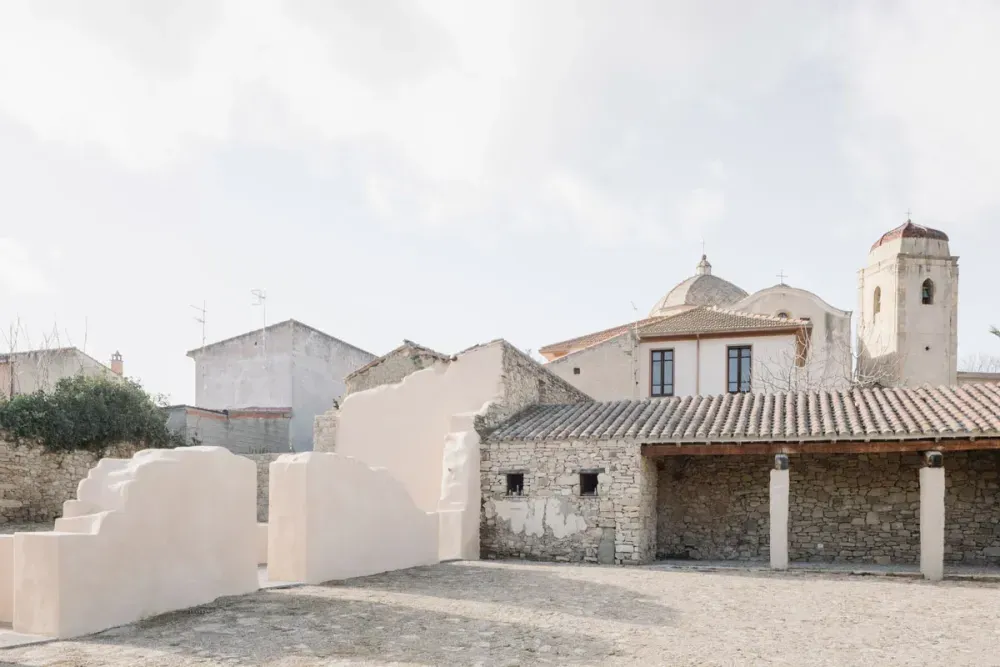
This portal has an archivolt surmounted by a dovecote with a roof of Sardinian tiles placed over reeds. It leads to a large courtyard where once there was a dwelling in the typical style of a Campidano house, of which few traces remain.
The portal was commissioned by Giuseppe Mascia, the father of the last owner, and was built in 1890.
On the entrance’s right jamb, as with other Simala portals, the abbreviation “E 209” appears, referring to the nineteen fifties and the battle conducted by the regional authority against malaria in Sardinia targeted at the anopheles mosquito that carried the disease.
The entire complex is now owned by the Simala Municipality, which has begun the initial renovation with the aim of creating a “traditional house” to attract tourists to the natural, architectural and cultural resources of Simala and the territory that surrounds it, with the aim of promoting awareness of the products of this land, so rich in history.
The last intervention was by the architect Martino Picchedda, whose design recalls the Cretto di Burri, located in the area of Gibellina Vecchia, which was completely razed to the ground during the Belice earthquake of 1968.
After the tremor, the whole town was moved to another area and, on the rubble of the original location, Alberto Burri created one of the largest landscape artworks in Europe between 1985 and 1989.