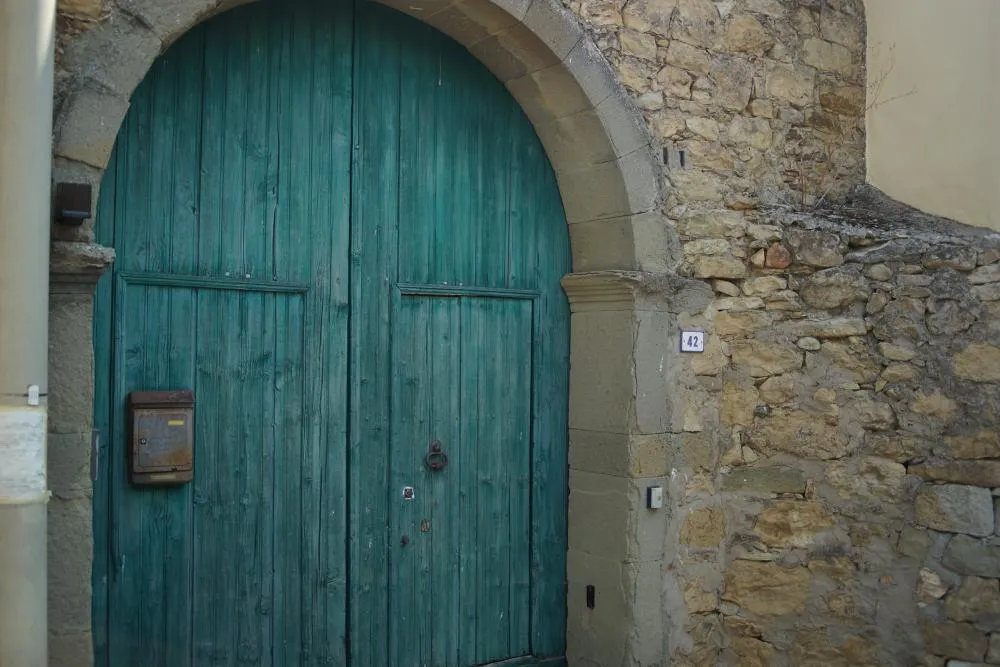

In the typical Marmilla house, the portal is the part that marks the passage between the public street and a private property. Sometimes, as in this case, it is the only entrance.
It was commissioned at the same time as the house in 1910 and had a dual role as a driveway and entrance to the residence which, with its high walls, appears impenetrable, mysterious, closed within it itself.
There is no opening in the high rear wall that borders a narrow alley, once cobbled, on which the waters from the gutters of this and the adjacent house converge and connects two different streets. The walls were built of local stone, so marl and sandstone of various sizes, while the spaces between the large ashlars were filled with small flakes of stone.
The only windows overlooking the street are on the short side of the house and are bordered by square sandstone blocks, one with an architrave of solid bricks.
The rooms all overlook the courtyard, the source of light and air.
Dwellings of this kind generally feature a courtyard with rounded pebbles laid on a bed of beaten earth and sand for compactness. Sometimes, especially in the older houses, the courtyard was covered with large but not very thick stone slabs, known as tallaias, which formed a paved floor.